What does garden decking cost in Ireland?
Source reviewed with 4 external references. How we review guides
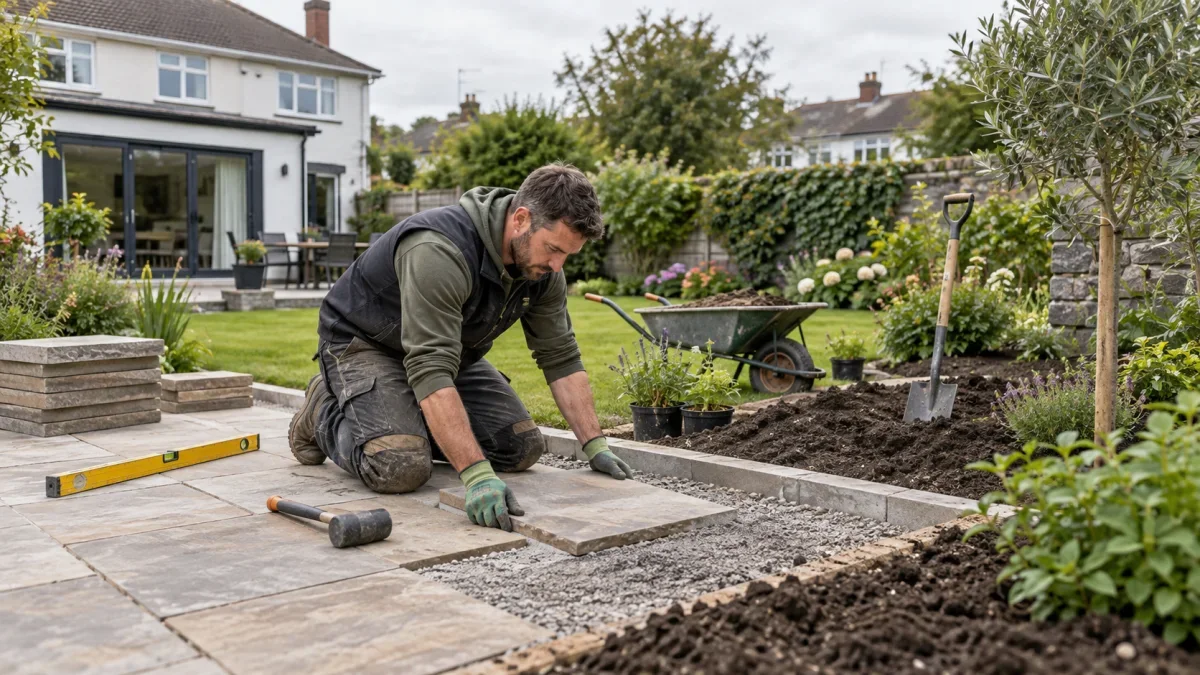
The price of decking boards is not the price of a finished deck. A safe, durable installation also needs a suitable base, posts or supports, a subframe, fixings, ventilation, drainage and finished edges. Steps, balustrades and removal of an old deck are usually separate cost drivers.
Two current Irish guides publish broadly consistent supply-and-fit ranges for a straightforward ground-level deck including its subframe: about €80–€130 per square metre for treated softwood and €150–€220 for standard composite. Premium composite is published at roughly €220–€290 or €300-plus per square metre. These are installer and merchant guide estimates, not official rates.[1][2]
This article shows how to turn the per-square-metre headline into a complete scope, compare timber with composite fairly and avoid a deck that traps moisture against the house.
Published Irish decking estimates checked October 2026
| Job | Indicative supply and fit incl. subframe |
|---|---|
| Pressure-treated softwood deckingStraightforward ground-level installation before steps, rails and difficult groundworks. | €80–€130 per m²[1][2] |
| Hardwood deckingInstaller-guide range including subframe for its stated straightforward scope. | €120–€190 per m²[1] |
| Standard composite deckingPublished supply-and-fit guide range including subframe. | €150–€220 per m²[1][2] |
| Premium capped compositeGuide range; board system and subframe specification matter. | €220–€300+ per m²[1][2] |
| Illustrative 20 m² treated-softwood deckGuide calculation before extras for a simple layout. | €1,600–€2,600[1][2] |
| Illustrative 20 m² standard-composite deckGuide calculation before steps, balustrades and access complications. | €3,000–€4,400[1][2] |
Prices are typical 2026 estimates and vary by job, condition and location.
Compare the complete structure, not the boards
Decking Dundalk explains that online board prices exclude the subframe, posts, joists, fixings, labour, waste and finishing. McMahons likewise separates boards-only figures from a complete supply-and-fit range. Ask every contractor to give the deck area and list the structural system beneath it.[1][2]
- Measured deck area and a dimensioned plan, including direction of boards.
- Ground preparation, excavation, membrane, foundations, posts and support spacing.
- Subframe material, treatment class, ventilation and separation from wet ground.
- Board manufacturer, product line, colour, profile, fixings and warranty.
- Fascias, picture-frame borders, steps, ramps, handrails and balustrades.
- Removal of soil or an old deck, delivery access, cleanup and VAT.
Timber and composite have different cost patterns
Treated softwood has the lowest published installed range but needs cleaning and periodic coating to manage appearance and weather exposure. Composite costs more initially and still needs cleaning, while product quality, expansion gaps and the manufacturer's subframe and fixing rules affect performance. Hardwood sits between or above these options depending on species and detailing.[1][2]
Ask for the maintenance instructions and written product warranty before choosing. Do not assume every board sold as composite has the same cap, slip performance, fading terms or installation method. The contractor's workmanship warranty and the board manufacturer's warranty cover different risks.
Ground, drainage and height can dominate the quote
A low rectangular deck on firm, accessible ground is the scope behind the clearest per-square-metre comparisons. Slopes, soft ground, retaining work, drainage changes, service covers, restricted access and many edges add labour and materials. The deck should not bridge a damp-proof course, obstruct ventilation or direct water toward the building.
A raised platform, boundary condition or project affecting overlooking can also need planning advice. Exempted-development rules are conditional, and the local authority can determine whether a proposal is exempt. Confirm the position before construction when height, boundaries or a sensitive property make it uncertain.[3]
A decking quotation request you can adapt
'Please survey and quote for approximately [area] m² of garden decking at a [house type] in [county]. The ground is [level/sloping/paved/soil], access is [describe], and the deck will sit approximately [height] above ground. Please provide separate options for [treated timber/composite], naming the board and subframe systems. Include foundations, membrane, fixings, ventilation, drainage details, edges, [number] steps, [length] balustrade, old-deck removal, waste, VAT and warranties. State planning, electrical, lighting and groundworks exclusions.'
The CCPC recommends researching contractors, checking recent references, securing written quotes and keeping payment records. For a larger deck, agree staged payments against visible progress rather than paying the complete price before the work is finished.[4]
Frequently asked questions
What does decking cost per square metre in Ireland?+
Current Irish guides estimate about €80–€130 per m² supplied and fitted for treated softwood and €150–€220 per m² for standard composite, assuming a straightforward ground-level deck including its subframe.[1][2]
What would a 20 m² deck cost?+
The cited guides translate their basic ranges to roughly €1,600–€2,600 for treated softwood or €3,000–€4,400 for standard composite. Steps, rails, removal, difficult ground and access are additional.[1][2]
Does the square-metre price include the subframe?+
The figures in this article do, for the simple scopes described by the sources. Confirm that each actual quote includes foundations or supports, subframe, boards, fixings and labour.[1][2]
Is composite decking maintenance-free?+
No. It normally avoids timber recoating, but it still requires cleaning and installation to the manufacturer's rules. Warranty, staining, fading and slip terms vary by product.
Sources and editorial notes
Numbered references link claims in this guide to the sources below. Sources were accessed during the article's research or latest material review.