Laminate floor lifting or swelling: what should a repair include?
Source reviewed with 2 external references. How we review guides
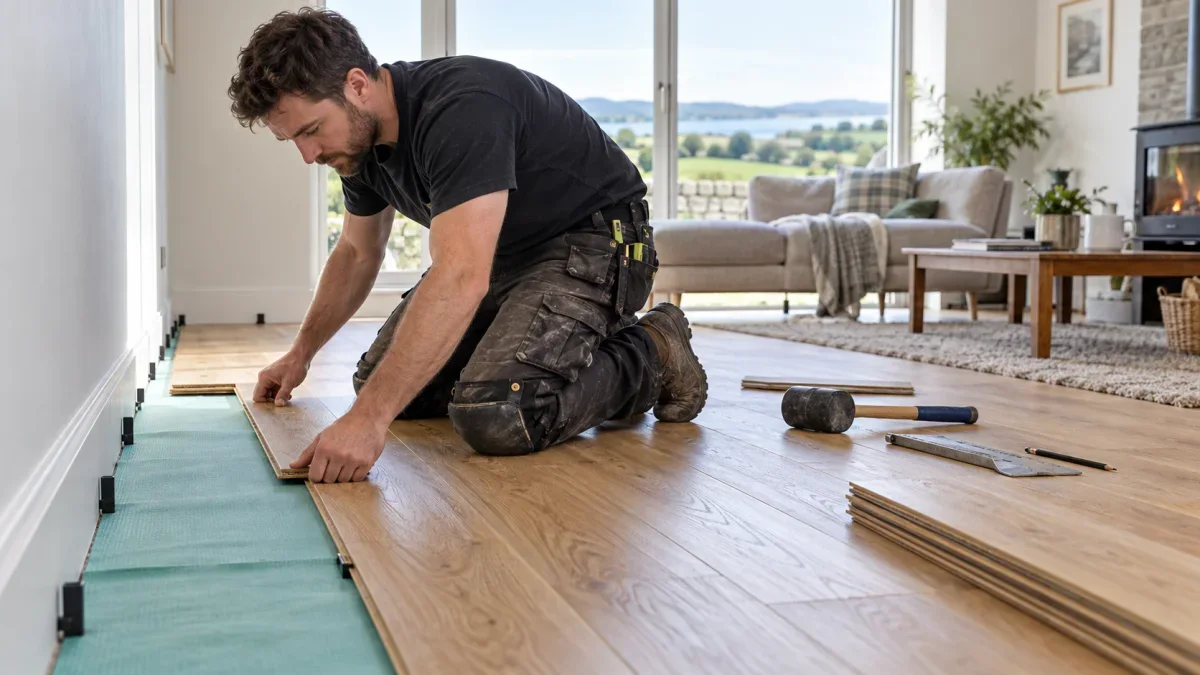
Laminate that rises in the middle of a room, feels uneven at a doorway or has swollen edges needs more description than 'floor damaged'. Those observations can lead to different investigations. The first decision is whether you need a flooring repair assessment, an active leak addressed or both.
Keep away from loose or raised sections that could cause a trip. Do not drive screws through the boards, cut around the room or lift the floor to investigate concealed heating and services. This guide helps you commission an appropriate repair; it does not diagnose the installation from its appearance.
Separate a raised area from a swollen board edge
Take a wider room photograph and a close-up of the visible change from a safe position. Say whether several boards rise together, individual edges look swollen or gaps have appeared. Record when the issue began, whether it is spreading and whether there was a known spill, appliance leak or recent installation.
If an active leak is suspected, have that assessed promptly rather than installing new boards over an unresolved water problem. Do not walk into standing water near electrical equipment. Explain to each business which problem needs attention so a flooring appointment is not mistaken for a plumbing emergency response.
Keep spare boards, packaging and purchase records. Confirm whether the product is actually laminate rather than engineered wood or click vinyl. Similar-looking surfaces have different instructions and repair options, so the product identity is more useful than a photograph labelled only 'wood floor'.
Ask about movement and moisture, without guessing
Quick-Step explains that humidity-related movement and insufficient space at the perimeter can contribute to a rising laminate floor. This is one manufacturer-described cause, not confirmation of the fault in your room. Ask the installer to assess the existing layout before assuming trimming or replacing a board will solve it.[1]
EGGER also describes deformation associated with insufficient acclimatisation and moisture from below where protection is inadequate. These are reasons to consider the installation and substrate, not just the surface. A repair proposal should distinguish a confirmed finding from a condition that still needs investigation.[2]
Tell the assessor about underfloor heating, recent building work and changes around thresholds or fitted units. Do not follow another product's expansion gap, humidity limit or heating schedule. Ask which instructions apply to your exact floor and what evidence supports the proposed remedy.
Compare local replacement with lifting a larger area
Ask whether the damaged boards can be replaced locally and what access the locking system requires. A spare pack does not guarantee a simple one-board repair. Establish whether skirting, thresholds or adjoining rooms need to be disturbed and who will reinstate them.
If the proposal is to replace the whole room, ask why that is necessary. Possible limitations should be explained rather than assumed: unavailable matching stock, damaged joints, the extent of affected material or an installation issue needing wider access. Get the agreed area and the replacement product in writing before ordering.
For a recently fitted floor, contact the original installer or retailer first and preserve the condition in photographs. Ask about the inspection and warranty process before authorising another business to alter it. A warranty decision and a repair quote are separate matters; neither should be guessed from a generic online guide.
Put the supporting work into the quote
- Assessment of the visible defect and any agreed moisture investigation.
- The area to be lifted, replaced or otherwise repaired.
- Subfloor preparation and compatible underlay where required.
- Skirting, trims, thresholds and door-clearance work.
- Furniture handling, protection and waste removal.
- The approval process for additional findings after lifting.
Compare the total for the completed repair, including VAT where applicable, with the same scope from another business. A new-floor laying rate does not necessarily include diagnosing and carefully dismantling an existing installation. Ask whether a separate inspection fee is credited towards the repair, if that is offered.
Do not accept a promise of an exact visual match without checking the product and batch position. Discuss how a repaired patch or threshold will look and what alternatives exist if the original board is unavailable. An honest description of the finish is more valuable than an unsupported assurance.
Agree the return-to-use instructions
Ask what was found, which components were changed and what remains outside the scope. Get the care instructions for the finished installation, including any heating or cleaning restrictions. Do not assume a steam cleaner, wet mop or heavy load is suitable simply because another laminate product permits it.
Keep the findings, product reference and invoice. If the same area rises again, contact the contractor with dated photographs rather than repeatedly altering the floor yourself. If moisture was involved, retain the separate leak-repair or drying records so the cause and the cosmetic replacement are not confused.
Post the symptom and request an assessment
Illustrative brief: 'Laminate in a Cork hallway has a raised area near a doorway and swollen edges beside an appliance cupboard. Product label, photos and spare boards available. Please assess the cause before proposing replacement. Quote access, any required preparation, board repair and reinstatement of trims separately. Underfloor services must not be disturbed without agreement.'
Browse flooring professionals in Ireland
Request the right repair: Post a laminate flooring job
Frequently asked questions
Can a lifting laminate floor be repaired without replacing everything?+
Sometimes, but the cause, locking system, extent of damage and available matching boards need assessment. Ask for the reason behind a local repair or whole-room proposal.
Is lifting always water damage?+
No. Manufacturer guidance also discusses movement and installation conditions. Describe the symptom and any known water event, but do not assume a cause without assessment.[1][2]
Should I buy replacement boards before the visit?+
Keep existing spares and product details, but ask the professional to confirm compatibility and the repair method before ordering more material.
Sources and editorial notes
Numbered references link claims in this guide to the sources below. Sources were accessed during the article's research or latest material review.
Official guidance and further reading
These links are further reading and do not substantiate every estimate above.