Sunken or uneven patio paving: repair or replace it?
Source reviewed with 2 external references. How we review guides
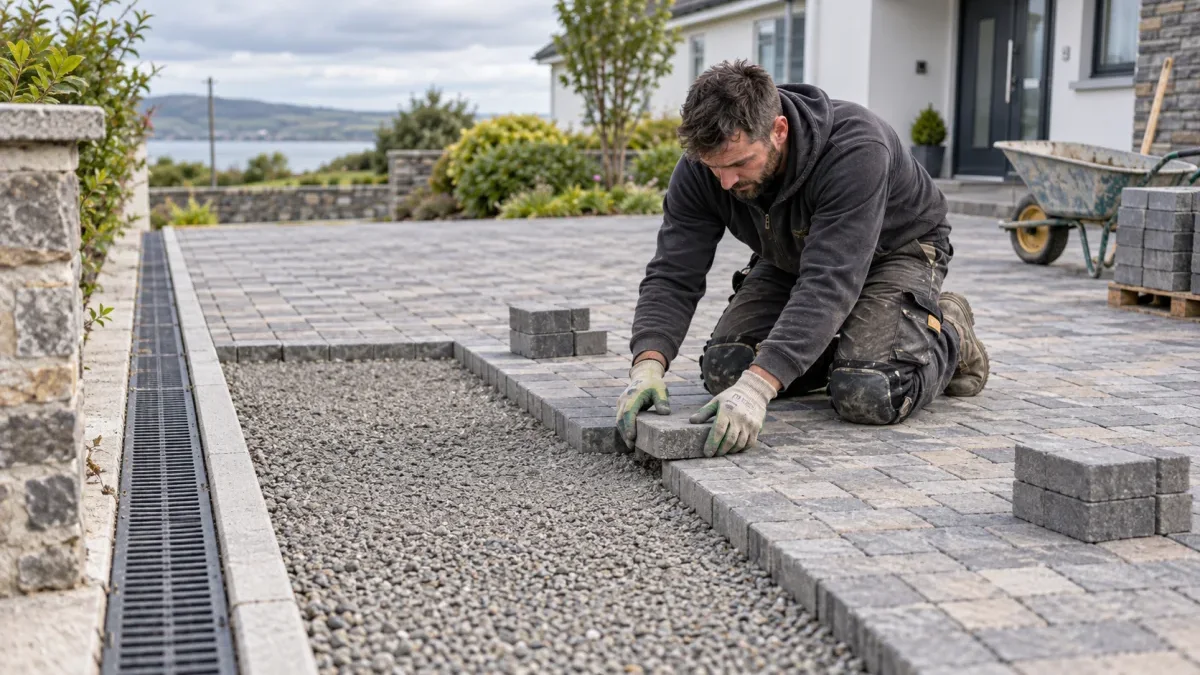
A patio that once felt level can develop a low patch, loose slab or awkward edge at the back door. The right enquiry is not automatically 'new patio'. A local repair may be possible, but the contractor needs to understand what has moved and how the area is built.
This guide helps Irish homeowners compare repair and replacement proposals. Keep people away from unstable or raised paving. Do not lift heavy slabs, excavate beside the house or use machinery to investigate a small dip before checking what lies below and agreeing an appropriate work plan.
Describe the area, not just the worst slab
Take a wide photograph showing the patio, nearby doors, edges and any drain. Add close-ups of the affected surface without standing on a loose slab. Give approximate dimensions and say whether the issue is one unit, a small depression or a wider area that has changed. Do not invent measurements if access is unsafe.
Record when you first noticed the change and any recent landscaping, drainage or building work. Mention where water collects after ordinary rain, but do not deliberately flood the patio as a test. Existing photographs from installation or an earlier summer can help show what has changed.
Identify the material if known: concrete flags, natural stone, porcelain or block paving. Keep spare units and product paperwork. A photo helps the enquiry, but the contractor should confirm the construction before selecting a repair method or ordering replacement pieces.
Ask what is happening beneath the surface
Ask the contractor what they have confirmed about the support, bedding, edges and drainage, and what can only be established after agreed lifting. A surface repair should explain which underlying issue it addresses. Do not accept a diagnosis of every low patch from appearance alone.
Tobermore publishes separate guidance for block paving, concrete slabs and permeable systems. Its installation FAQs distinguish construction methods, which is a useful reminder that not all patios have the same build-up. Ask the business to identify the existing system rather than applying a single repair recipe to every surface.[1]
Where paving changes coincide with wider ground movement, building cracks or an unexplained void, ask for appropriate assessment before covering the area. Do not treat a paving quote as a structural report. Mark the area as unsafe to use if necessary and explain the concern when arranging attendance.
Keep permeable paving different from ordinary jointing
If the patio is part of a permeable system, tell the contractor before anyone fills its joints. Tobermore's Hydropave guidance relies on specified materials and warns against contaminating permeable joints with soil. An ordinary sand or mortar top-up should not be assumed compatible with that system.[2]
Ask whether the planned repair preserves the existing drainage function and whether any proposed change affects neighbouring areas. Do not redirect water towards the house or a boundary as a convenient way to remove a puddle. Request a clear explanation of where surface water will go after the work.
Likewise, a decorative sealer or thorough clean is not a substitute for a repair to unstable paving. Keep the cosmetic work separate in the quotation so you can see what makes the surface usable and what merely changes its appearance.
Compare lifting and relaying with replacement
Ask whether existing units can be reused and how the contractor will handle breakage or an unavailable match. A repair may leave a visible boundary between old and new material. Discuss that before approving removal, especially where the patio adjoins a step, threshold or carefully matched path.
- The measured area to be lifted and the limits of the repair.
- Assessment and remedial work below the surface.
- Reuse, replacement and matching of paving units.
- Edges, joints and drainage details included in the proposal.
- Waste removal, access protection and reinstatement.
- The process for approving extra work if lifting reveals more damage.
A full replacement proposal should explain why a local repair is unsuitable. Ask for the different scopes in writing instead of comparing a small repair's total with an advertised new-patio price per square metre. Include VAT where applicable and any access or disposal charge in the complete comparison.
Plan access and check the handover
Describe narrow gates, steps, parking restrictions and anything that limits material handling. Tell the contractor about known services or inspection covers, but do not guess their route or lift covers yourself. Ask how the garden and adjacent finishes will be protected during the work.
Before completion, ask for the repair area, materials and any remaining limitations to be recorded. Get instructions on when it can be walked on, loaded, cleaned or otherwise used. Keep before-and-after photographs and agree whom to contact if the same area moves again.
If the original paving is recent, give the installer an opportunity to inspect and check the written warranty process before commissioning another business. A product guarantee and an installation warranty are not automatically the same commitment; establish who is responsible for the work being proposed.
Write a patio-repair request
Illustrative brief: 'Small area of concrete patio flags in an Offaly garden has become uneven and holds water after rain. Wide and close-up photos available. Please assess the construction and quote a local lift-and-relay if suitable, with replacement units and any drainage work separately identified. Narrow side-gate access; no excavation authorised before agreement.'
Find paving and driveway professionals
Ask for a repair assessment: Post a patio-paving job
Frequently asked questions
Does sinking paving mean I need a whole new patio?+
Not necessarily. Ask the contractor to establish the extent and cause, then explain whether a local repair is suitable. Get the rationale for any wider replacement proposal.
Can I just fill the low area or joints?+
Do not assume a surface top-up resolves the underlying problem. Permeable systems also require compatible jointing materials. Identify the construction before agreeing to a repair.[2]
Will reused paving look exactly the same?+
Do not assume so. Discuss breakage, spare units, batch differences and the visible repair boundary before lifting. Ask the contractor to explain realistic matching options.
Sources and editorial notes
Numbered references link claims in this guide to the sources below. Sources were accessed during the article's research or latest material review.
Official guidance and further reading
These links are further reading and do not substantiate every estimate above.